





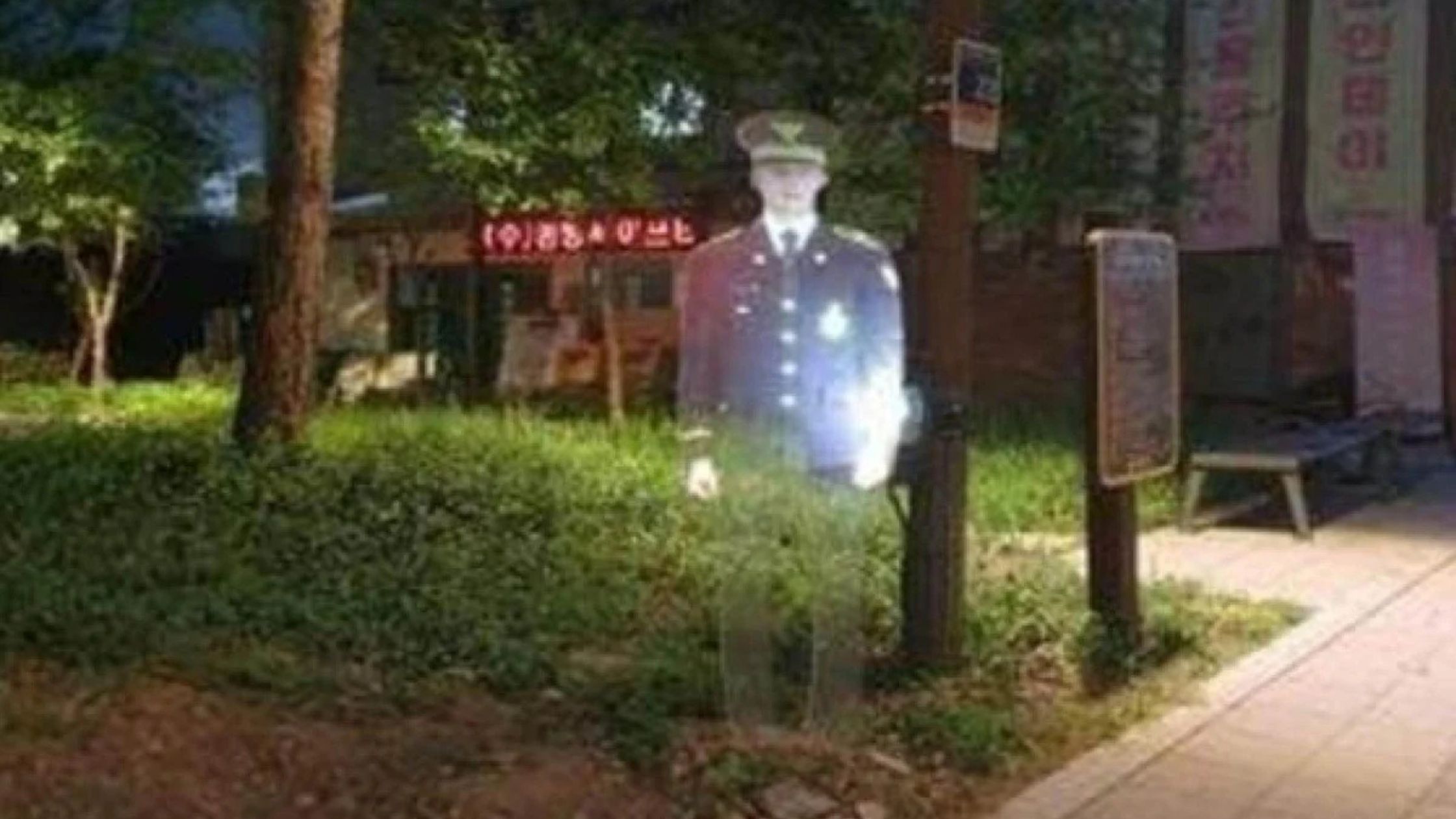
South Korea has introduced an unusual yet effective approach to public safety—life-sized holographic police officers. In Seoul’s Judong No. 3 Park, a digital officer appears every evening between 7 and 10 p.m., issuing reminders about CCTV surveillance and assuring residents that real officers are ready to respond immediately if needed. The projection, created by tech firm Hologrammica in partnership with the Seoul Metropolitan Police Agency, is modeled after an actual officer and stands at about 170 centimeters tall in full uniform.

Authorities say the initiative is more than a showcase of technology. Since its launch under the city’s “Safe Park” program in late 2024, incidents of crime in the area have fallen by roughly 22 percent. Officials highlight that the project was aimed at neighborhoods where disturbances linked to alcohol and violent behavior are common, and early results suggest the holographic patrol is succeeding in deterring unlawful activity.
The officer’s projection was designed to function year-round, so the uniform chosen was the standard dress outfit, considered appropriate for all seasons. According to police officials quoted in The Chosun Daily, the hologram has drawn particular interest from the foreign community living nearby, who see it as both novel and reassuring.
At night, the holographic figure glows faintly blue, appearing every two minutes to deliver a pre-recorded message. It reminds visitors that the park is under camera surveillance and assures them that police will respond immediately if emergencies arise. After each message, the figure fades, only to reappear again moments later.
Developed by the local tech firm Hologrammica, the installation has been in place since October 2024 under Seoul’s “Safe Park” program. The initiative focuses on areas known for frequent disturbances tied to alcohol consumption and violent behavior, where conventional patrols have often been stretched thin.
Although the hologram cannot physically intervene or carry out arrests, police argue that its psychological influence is meaningful. “While anyone can tell on closer inspection that it is not a real officer, the perception of police presence alone has created a strong deterrent effect,” the Seoul Metropolitan Police Agency said in a statement.
Crime statistics appear to support that claim. Data comparing October 2023 to May 2024 with the same period after the installation shows reported incidents during those evening hours fell by about 22 percent. The drop has given police confidence that the system is having a measurable impact on safety.
Public opinion, however, has been divided. Some residents have praised the project as a creative use of technology, while others mocked it online, calling the glowing projection a “ghost police officer.” One social media user described the figure as “laughable but still useful,” noting that security cameras were attached to it.
Despite mixed reactions, police leaders regard the pilot as a success. Jungbu Police Station chief Ahn Dong-hyun described the hologram as a “smart security device” that improves citizens’ sense of safety while discouraging disruptive behavior. He confirmed that authorities are now planning to expand the use of similar holographic patrols into other public spaces as part of Seoul’s broader crime prevention strategy.
Image credits: Seoul Metropolitan Police Agency