







Statistics and research suggest structural supply issues — not large-scale speculative ownership — may be the deeper driver of housing instability
President Lee Jae Myung has sharpened his rhetoric on the housing market, arguing that rising home prices and growing insecurity among non-homeowners are largely the result of multiple-property owners dominating supply. In recent public remarks and social media posts, he indicated that tightening tax rules and removing benefits for multi-homeowners is necessary to restore fairness and stabilize the market.

At a Cabinet meeting at Cheong Wa Dae, Lee instructed officials to design measures that would make it effectively “impossible” for such owners to retain existing tax advantages. The tougher stance, delivered ahead of the June 3 local elections, prompted criticism from the main opposition People Power Party, which argued that punitive signals toward property holders do not address deeper structural imbalances in housing supply and finance.
Official housing statistics present a more nuanced picture. The number of multiple homeowners in the capital region increased from about 870,000 in 2015 to 1.05 million in 2020, during a period of market recovery. However, following heavier comprehensive real estate taxes and rising interest rates, the figure declined for two consecutive years before edging up slightly to 1,053,421 in 2024.
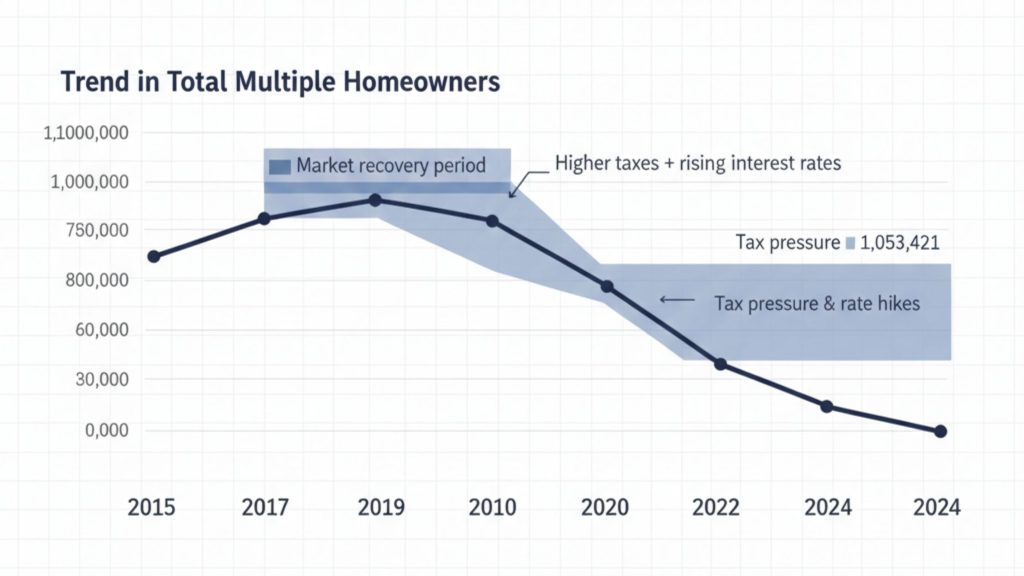
More importantly, the internal composition of this group has shifted. Between 2022 and 2024, the number of individuals owning two homes rose, while those holding three or more properties fell by over 2,300. This trend challenges the narrative of a rapid surge in large-scale speculative ownership involving dozens or hundreds of properties. Analysts note that many additional holdings arise from inheritance or family transfers rather than aggressive market purchases.
The proportion of multiple homeowners among all homeowners in the capital region has also been decreasing. After peaking at 15.6 percent in 2019, the share fell to 13.9 percent in 2024 — the lowest level in nearly a decade. Population inflows into the capital region, which expanded the base of single-home households, are cited as one factor behind the relative decline.
Bulk Purchases and Market Structure
High-profile cases of bulk purchases have often been highlighted in political debate. Data released last year showed that the top 100 buyers acquired 4,115 housing units worth 663.9 billion won over six years. While the figures appear large, the average purchase price per unit was around 160 million won — significantly below the price of typical Seoul apartments.
Experts argue that this distinction matters. A substantial share of Seoul’s housing stock consists of multi-family and small multi-household units. Many owners of such properties are retirees or small-scale investors seeking rental income. Categorizing these holdings as the primary driver of apartment price increases may overlook differences between housing types and market segments.
Tax Burdens and Ownership Incentives
South Korea’s tax structure already places considerable pressure on multi-homeowners. Comprehensive real estate tax rates for those owning three properties can reach up to 5 percent. Simulations indicate that a person holding five properties worth 2 billion won each could face a higher annual tax burden than someone owning a single 10 billion won home, while single-homeowners benefit from various deductions.
Tax specialists note that when rental income taxes, maintenance costs, and financing expenses are included, profitability for owners of three or more properties in Seoul can be significantly reduced. This raises questions about whether the current environment strongly incentivizes large-scale speculative holding.
Research has also pointed to possible unintended consequences of stricter tax measures. A 2023 study by the Korea Research Institute for Human Settlements found that a 1 percentage point increase in transfer income tax rates was associated with a 0.206 percentage point rise in apartment price growth. The study suggested that higher transaction taxes may discourage sales, reducing available supply — a so-called “lock-in effect.”
Such dynamics complicate the assumption that heavier taxation will automatically lower prices. If owners choose to hold properties in anticipation of future policy changes, supply constraints could intensify.
Policy Debate Ahead
Despite these concerns, the administration has decided to end the temporary suspension of heavier capital gains taxes on multi-homeowners on May 9. President Lee has framed the move as both urgent and necessary, arguing that the government has the authority and tools required to act decisively and prevent owners from waiting out policy shifts.
Critics, including the People Power Party, warn that strong rhetoric and regulatory pressure may heighten uncertainty without resolving structural issues such as limited supply, financing constraints, and regional demand concentration. As the debate continues, the distinction between politically resonant messaging and data-driven policy design is likely to remain central to South Korea’s housing discourse.