






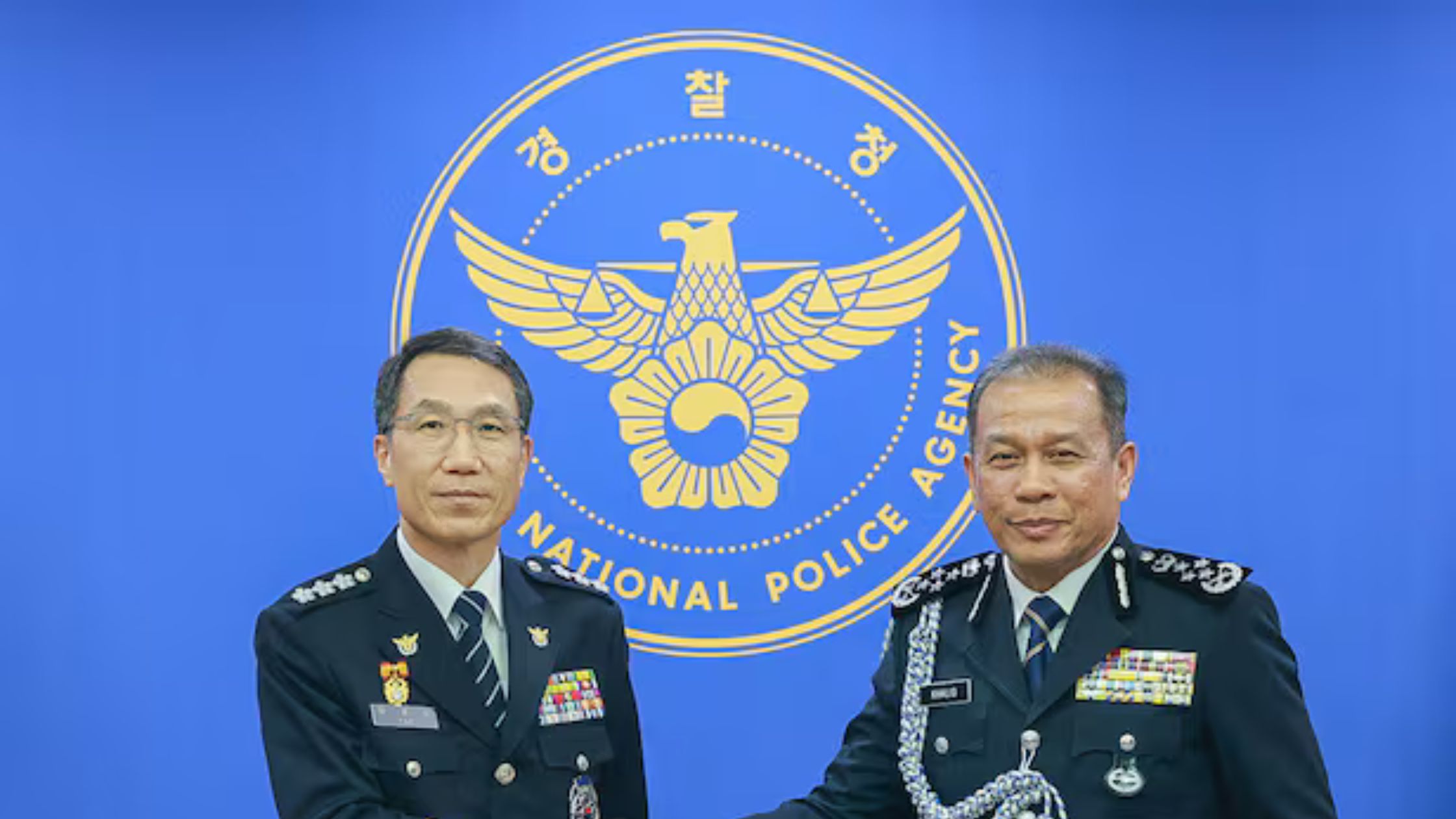
Agreement expands intelligence sharing, joint operations, and asset recovery as online fraud losses mount in both countries
Police authorities of South Korea and Malaysia have signed a memorandum of understanding (MoU) aimed at strengthening cooperation against transnational crime, with a focus on online scam syndicates operating across borders. The agreement was concluded in Seoul following talks between Yoo Jae-seong, acting commissioner general of Korea’s National Police Agency, and Malaysia’s Inspector-General of Police Datuk Seri Mohd Khalid Ismail.

Officials said the framework is designed to institutionalise collaboration at a time when scam operations have grown more organised and geographically dispersed, particularly across parts of Southeast Asia.
Under the MoU, the two sides agreed to accelerate the exchange of information related to cross-border crimes, including scam compounds active in the region. The agreement sets out practical cooperation measures such as joint investigations, coordinated enforcement actions, and the arrest and repatriation of suspects.
It also includes provisions for tracing, freezing, and recovering criminal proceeds — an increasingly important element as fraud networks rely on rapid cross-border fund transfers and digital payment channels. By formalising these mechanisms, both countries aim to reduce procedural delays that often hinder transnational investigations.
Push for Multilateral Coordination
During the meeting, Yoo invited Malaysia to join an international cooperation council launched by South Korea last October. The council was established following a global police conference hosted in Seoul and is intended to build a broader multilateral network to counter organised scam crimes.
Malaysian authorities indicated they would review the proposal and explore participation. Ismail said Kuala Lumpur is open to deeper discussions on structured cooperation to address evolving forms of cyber-enabled crime. Officials on both sides acknowledged that scam tactics are adapting quickly, making sustained international coordination necessary.
Protecting Nationals in Southeast Asia
The agreement comes amid heightened concern in South Korea over crimes targeting its citizens in Southeast Asia. Korean authorities have been responding to reports of abductions and forced confinement of South Koreans in Cambodia, allegedly linked to criminal rings operating scam centres in the region.
These incidents have drawn attention to the operational scale of scam syndicates, which often recruit or coerce individuals into working in overseas fraud compounds. Seoul has since sought stronger law enforcement partnerships to prevent such cases and ensure faster cross-border responses.
Rising Financial Impact
The financial toll has added urgency to bilateral efforts. In South Korea, losses from voice phishing last year were estimated at around 1 trillion won, reflecting the sustained domestic impact of online fraud.
Malaysia has also faced significant damage, reporting losses of about 277 million ringgit — roughly 830 billion won — from online and financial scams. Authorities from both countries described scam-related crime as a national-level security and economic concern, arguing that structured cross-border frameworks are essential to dismantle the networks behind these operations.
With the MoU now in place, the effectiveness of the partnership will depend on how quickly operational coordination translates into measurable enforcement outcomes.