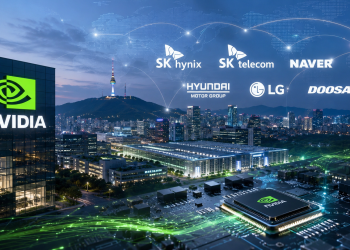





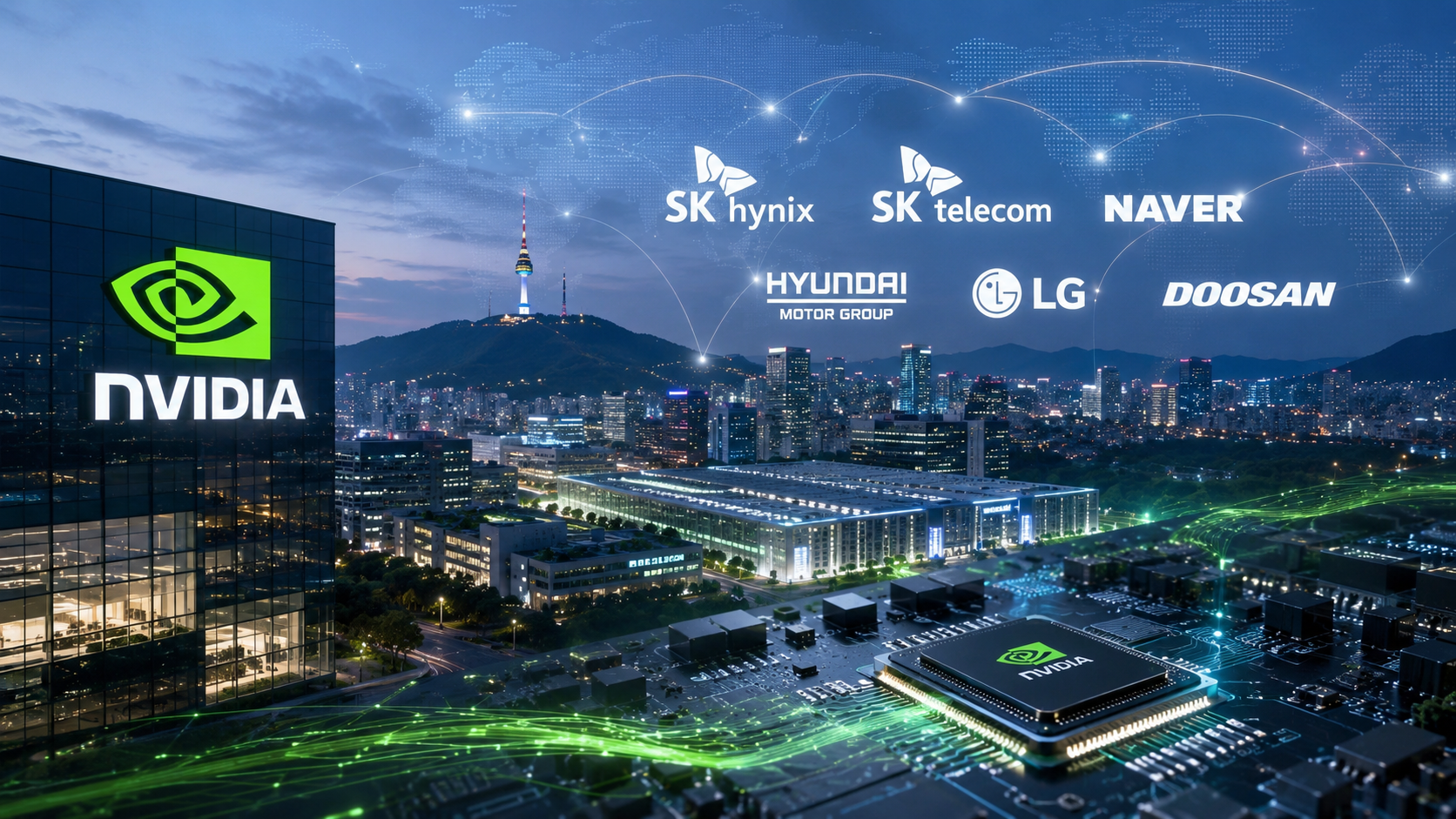
Partnerships spanning SK hynix, SK Telecom, Naver, Hyundai, LG, and Doosan highlight South Korea’s expanding role in the global AI economy as demand for AI infrastructure accelerates.
Nvidia’s latest wave of partnerships with South Korean technology and industrial giants reflects a major shift in the global artificial intelligence landscape, positioning South Korea not merely as a semiconductor supplier but as an increasingly important AI infrastructure market.

During a high-profile visit to South Korea in the second week of June, Nvidia CEO Jensen Huang announced a series of strategic agreements involving SK Group, SK hynix, SK Telecom, Naver, Hyundai Motor Group, LG Group, and Doosan Group. The agreements cover AI memory, hyperscale AI infrastructure, cloud systems, robotics, industrial automation, and sovereign AI initiatives. The announcements come as demand for AI computing infrastructure surges globally and governments increasingly treat AI capabilities as a strategic economic priority.
The scale of the partnerships underscores how rapidly South Korea is moving beyond its traditional role as a semiconductor manufacturing powerhouse into a broader position within the global AI infrastructure race. The country now participates across multiple layers of the AI ecosystem, including advanced memory production, AI cloud systems, sovereign AI models, robotics, industrial automation, telecom infrastructure, and hyperscale data centers. Few countries currently participate across such a wide range of interconnected AI sectors.
That expanding ecosystem has made South Korea increasingly important to Nvidia’s long-term strategy as the company pushes beyond GPUs into broader AI infrastructure development.
SK hynix and the Global AI Memory Bottleneck
Among the various announcements, the most strategically significant may involve SK hynix, which has emerged as one of Nvidia’s most critical suppliers of high-bandwidth memory, or HBM, a key component used in advanced AI accelerators and AI servers.
Nvidia and SK hynix announced a multiyear partnership focused on developing next-generation memory technologies designed for large-scale AI infrastructure and so-called “AI factories.” HBM has become one of the biggest constraints in the global AI boom because modern AI systems require enormous amounts of high-speed memory to process increasingly complex workloads efficiently.
According to Reuters, SK hynix controlled roughly 58% of the global HBM market during the first quarter of 2026, significantly ahead of Samsung Electronics and Micron. The company has also announced plans to double wafer capacity over the next several years as AI-related memory demand continues to rise. Huang said during the visit that even substantial production expansion may not be enough to meet future AI infrastructure demand.
The imbalance between AI demand and memory supply highlights South Korea’s growing influence in the global AI economy. As AI adoption expands worldwide, memory infrastructure has become nearly as important as GPUs themselves, elevating companies such as SK hynix into strategically important positions within the AI supply chain.
The company’s growing role has also reshaped South Korea’s financial markets. AI-related semiconductor demand has sharply increased valuations for Korean chipmakers, with SK hynix emerging as one of the biggest beneficiaries of the global AI investment boom.
Nvidia’s AI Factory Vision Takes Shape in Korea
A central theme throughout Nvidia’s announcements in South Korea was the concept of “AI factories,” a term the company increasingly uses to describe hyperscale AI infrastructure systems designed to train models, generate AI outputs, support robotics operations, and power industrial AI workloads.
Unlike conventional cloud data centers, AI factories require tightly integrated combinations of GPUs, high-bandwidth memory, networking systems, cloud software, and energy infrastructure. South Korea is rapidly becoming one of Nvidia’s key deployment markets for this type of infrastructure.
SK Telecom announced plans to develop a gigawatt-scale AI cloud platform in South Korea using Nvidia technologies, while Naver unveiled plans to build gigawatt-scale AI factories beginning with deployments at its GAK Sejong data center. The projects are expected to support enterprise AI services, sovereign AI models, robotics systems, industrial AI applications, and AI cloud infrastructure across Asia.
The scale of the projects highlights South Korea’s growing importance within the global AI infrastructure market.
Sovereign AI Becomes a Strategic Priority
One of the most significant aspects of the Nvidia-Naver partnership is its connection to sovereign AI. South Korea increasingly views domestic AI infrastructure and Korean-language AI systems as matters of national competitiveness and digital sovereignty. Naver’s HyperCLOVA platform has become one of the the country’s flagship sovereign AI initiatives, developed using extensive Korean-language datasets and localized digital ecosystems. The company has positioned the platform as an alternative to reliance on U.S. or Chinese AI ecosystems.
The partnership with Nvidia suggests sovereign AI is emerging as a major infrastructure category rather than simply a national technology initiative. Countries worldwide are increasingly seeking local AI infrastructure, domestic cloud systems, sovereign language models, and more independent AI ecosystems. South Korea has emerged as one of the more active countries pursuing sovereign AI infrastructure strategies.
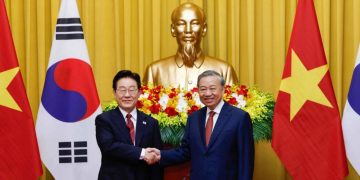
The timing is particularly significant as President Lee Jae Myung’s administration pushes to expand domestic AI infrastructure, increase AI computing capacity, and strengthen South Korea’s long-term technological competitiveness.
Korea’s Push Into Physical AI
The partnerships also revealed how aggressively South Korea is expanding into what Nvidia describes as “physical AI.” Unlike generative AI applications focused primarily on software and language models, physical AI involves robotics, industrial automation, autonomous systems, and AI-enabled manufacturing. Nvidia deepened cooperation with Hyundai Motor Group, LG Group, and Doosan Group on projects involving robotics, mobility AI, humanoid systems, and industrial automation infrastructure.
Hyundai is developing AI-enabled mobility and robotics initiatives tied to its broader smart manufacturing strategy, while LG and Doosan are exploring applications involving humanoid robotics, industrial automation, and AI-powered data center systems. Huang described robotics as potentially becoming South Korea’s “next major sector” during his visit, reflecting Nvidia’s growing focus on embodied AI and industrial systems beyond traditional computing markets.
That direction aligns closely with South Korea’s existing industrial strengths in manufacturing, automotive systems, electronics, and industrial engineering.
Why Nvidia Increasingly Relies on South Korea
While much of the discussion surrounding the partnerships has focused on how South Korea benefits from Nvidia’s expansion, the relationship is becoming increasingly interdependent. Nvidia is becoming increasingly reliant on South Korea’s advanced memory production and AI infrastructure ecosystem. As global AI demand accelerates, the company requires stable supply chains and regional infrastructure partners capable of supporting long-term AI deployment at scale.
South Korea provides one of the few ecosystems capable of supporting multiple layers of the AI infrastructure stack simultaneously, ranging from semiconductors and memory to robotics, telecom infrastructure, and sovereign AI platforms. That has elevated the country from a critical semiconductor supplier into a key infrastructure partner within the global AI economy.
AI Is Reshaping South Korea’s Economic Future
The broader implications extend far beyond individual corporate partnerships. Artificial intelligence is increasingly reshaping South Korea’s industrial policy, export economy, equity markets, and national growth strategy. AI-related semiconductor demand has fueled strong export growth and significantly boosted valuations for Korean technology firms. Semiconductor companies including SK hynix and Samsung Electronics have become major beneficiaries of the global AI investment cycle.
At the same time, South Korea’s government has intensified efforts to expand AI infrastructure, strengthen sovereign AI capabilities, and position the country as one of the world’s leading AI economies.
The convergence of semiconductors, cloud infrastructure, sovereign AI, robotics, and industrial automation is reshaping how South Korea defines its future economic identity. The Nvidia partnerships suggest that transformation is accelerating rapidly.
South Korea is no longer simply supplying components for the AI era. It is increasingly becoming one of the key infrastructure ecosystems supporting the next phase of the global AI economy.