


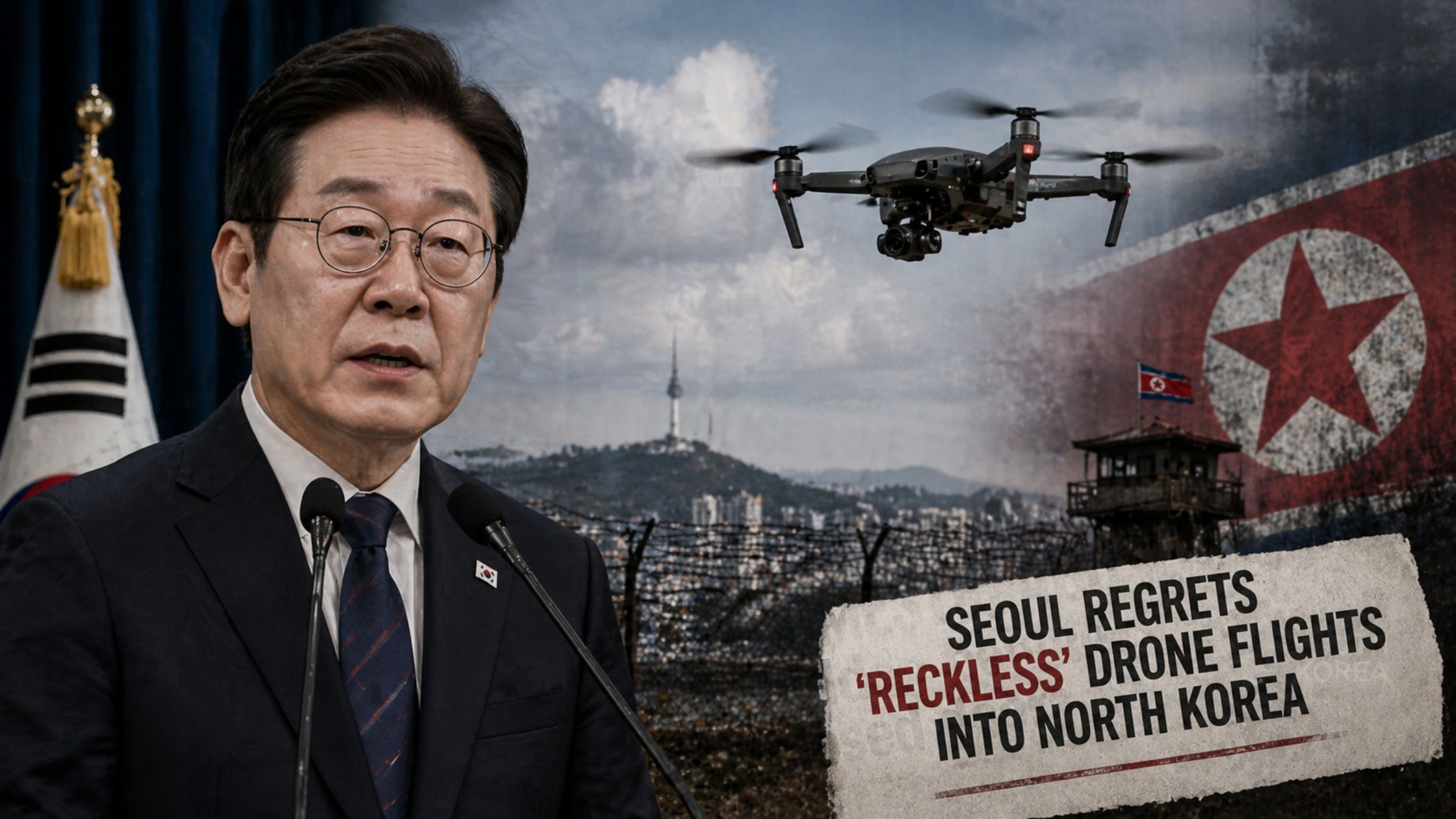
President Lee Jae-myung acknowledges missteps as investigation links operation to state personnel
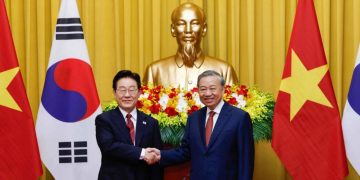
South Korean President Lee Jae-myung has expressed regret over drone flights that entered North Korean airspace, marking a rare public acknowledgment of responsibility in a situation that has exposed deeper concerns around oversight and escalation on the Korean Peninsula.

“We express regret to the North over the unnecessary military tensions caused by the irresponsible and reckless actions of some individuals,” Lee told South China Morning Post in early April, framing the incident as both a miscalculation and a lapse in control.
The issue first emerged when South Korean authorities confirmed that drones had crossed into North Korea. Early explanations pointed to civilian involvement, allowing the government to distance itself from the activity.
That position has since become difficult to sustain. Investigations indicate that individuals connected to state institutions, including intelligence and military personnel, were involved. This shift has transformed the episode from a limited provocation into a broader institutional question, centering on how such an operation could proceed without clearer authorization or restraint.
Acknowledgment and Its Implications
Lee’s choice of language is notable. By describing the actions as “reckless,” the administration has implicitly accepted that the operation crossed strategic and political boundaries. In the context of inter-Korean relations, such phrasing carries weight, signaling to both domestic and external audiences that the government views the incident as a serious misstep rather than a marginal breach.
At the same time, the framing places responsibility on “individuals,” suggesting an effort to contain institutional fallout while still addressing the diplomatic consequences.
The drone flights had already triggered warnings from Pyongyang, which cautioned earlier this year that further incursions could provoke a strong response. The warning underscored how even limited aerial intrusions can be interpreted as deliberate provocations.
Following Lee’s remarks, North Korea responded in a more measured tone, describing the expression of regret as “wise.” While modest, the reaction suggests that Seoul’s acknowledgment may have helped prevent immediate escalation, at least at a rhetorical level.
Structural Gaps in Oversight
Beyond the immediate diplomatic impact, the episode points to a more structural issue within South Korea’s security framework. The involvement of personnel linked to state institutions raises questions about internal coordination, command clarity, and accountability.
Drone operations, particularly in the context of North Korea, are not merely tactical tools. They function as political signals. When such actions appear to fall outside clear lines of control, they risk undermining both deterrence credibility and diplomatic positioning.
For the Lee administration, the challenge now is twofold: to clarify how the operation occurred and to demonstrate that safeguards are in place to prevent similar incidents.
The case also highlights the limits of ambiguity in security operations on the Korean Peninsula. While plausible deniability can sometimes serve strategic purposes, it becomes less effective when evidence points to institutional involvement.
In this instance, the gap between initial explanations and later findings has created a credibility issue that extends beyond the incident itself. Managing that gap will be critical to maintaining both domestic trust and international confidence.
What Comes Next
The broader context remains one of persistent volatility. Inter-Korean relations are shaped by a narrow margin for error, where even small-scale actions can carry disproportionate consequences.
This episode reinforces a recurring dynamic: that unintended escalation is often not the result of large, deliberate moves, but of limited actions that are poorly controlled or insufficiently assessed.
As investigations continue, attention is likely to focus on accountability and institutional reform. The outcome may influence how South Korea approaches not only drone operations, but the broader balance between intelligence activity and diplomatic restraint.
Lee’s remarks may have helped stabilize the immediate situation, but they have also opened a deeper conversation about control, responsibility, and the risks of miscalculation. In a security environment as sensitive as the Korean Peninsula, those questions are unlikely to fade quickly.