

State visits from March 1–4 to focus on AI, nuclear energy, defence cooperation and ASEAN coordination
South Korean President Lee Jae Myung will undertake state visits to Singapore and Philippines from March 1 to 4, as Seoul seeks to expand bilateral ties into emerging sectors such as artificial intelligence and nuclear energy. According to Cheong Wa Dae, the four-day trip is designed to strengthen existing economic cooperation while positioning South Korea more firmly within Southeast Asia’s long-term growth agenda.

The visit comes at a time when South Korea is recalibrating its engagement with the Association of Southeast Asian Nations (ASEAN), placing greater emphasis on technology partnerships, supply chain resilience and defence collaboration. The sequential visits to two key ASEAN members — one the current chair and the other the incoming chair — reflect a structured diplomatic approach rather than a routine bilateral exchange.
Singapore: Expanding a Strategic Partnership
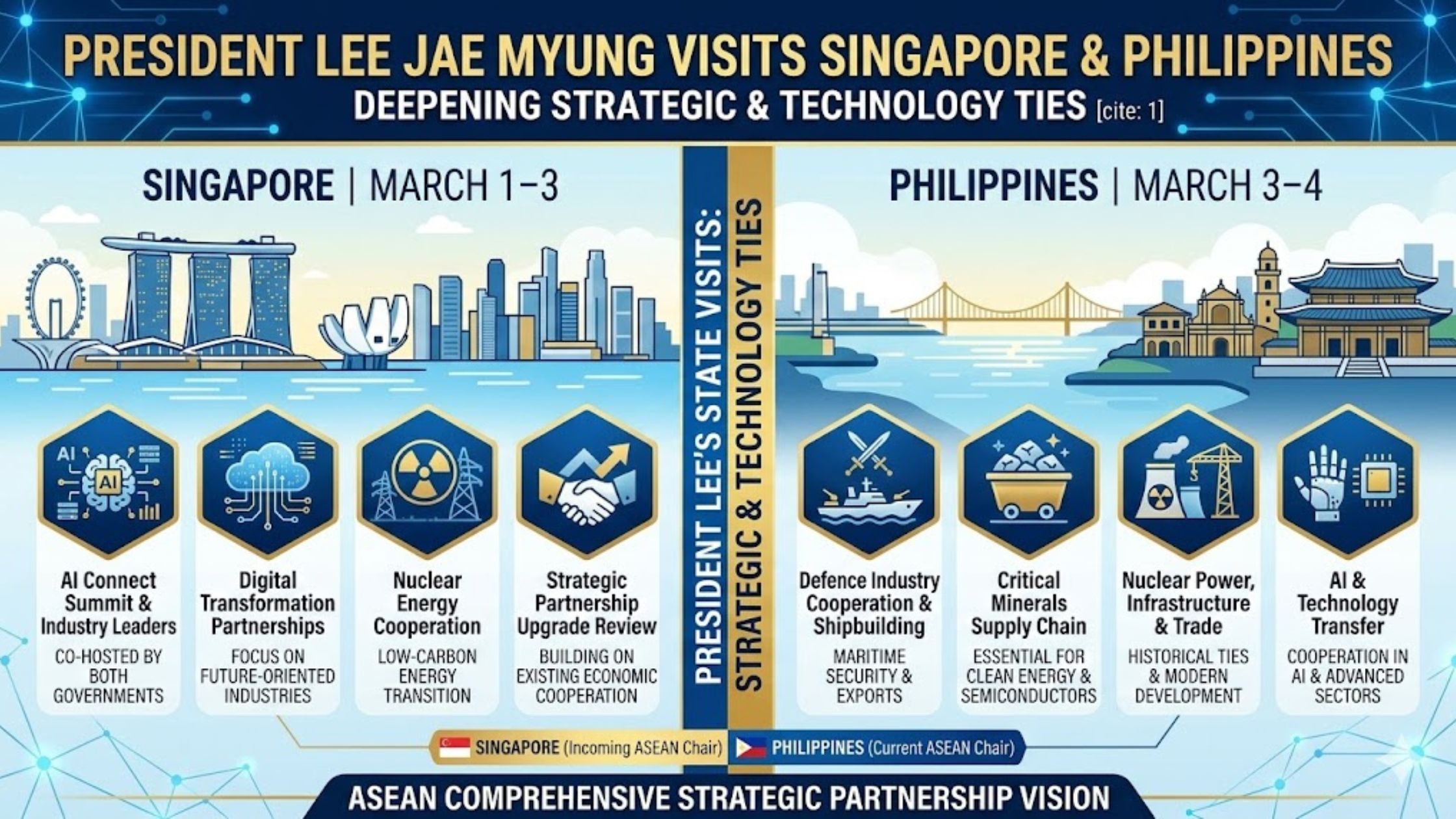
From March 1 to 3, Lee will visit Singapore for summit talks with Prime Minister Lawrence Wong and a meeting with President Tharman Shanmugaratnam. The leaders are expected to review progress since the two countries upgraded relations to a strategic partnership last year.
Singapore is a regional hub for finance, logistics and trade, and South Korea views it as a gateway for deeper integration into Southeast Asia’s innovation networks. Lee is scheduled to attend the AI Connect Summit, co-hosted by both governments, where he will meet industry leaders and technology experts. Officials have indicated that cooperation in artificial intelligence and nuclear energy will be central themes.
For Seoul, expanding into AI and advanced energy collaboration signals a shift from traditional manufacturing-led ties toward high-value, future-oriented industries. It also reflects South Korea’s effort to secure partnerships in areas linked to digital transformation and low-carbon energy transitions.
Philippines: Defence, Infrastructure and Strategic Alignment
Following his Singapore visit, Lee will travel to Manila from March 3 to 4 for talks with President Ferdinand Marcos Jr.. The summit will coincide with the 77th anniversary of diplomatic relations between the two countries, underscoring long-standing historical ties.
The agenda in Manila is expected to include defence industry cooperation, infrastructure development, trade and critical minerals. Discussions will also cover nuclear power, shipbuilding and artificial intelligence. A business forum involving companies from both countries is scheduled alongside the state banquet.
The Philippines holds strategic importance for Seoul. It was the first Southeast Asian nation to establish diplomatic relations with South Korea and contributed troops during the Korean War. Today, cooperation extends to defence exports, infrastructure investment and maritime security. The inclusion of critical minerals in the agenda reflects growing global competition over supply chains essential for clean energy and semiconductor production.
ASEAN Strategy and the CSP Vision
Cheong Wa Dae has framed the visits within South Korea’s broader Comprehensive Strategic Partnership (CSP) vision toward ASEAN. The Philippines currently chairs ASEAN, while Singapore will assume the role next year. Engaging both governments in succession allows Seoul to align its bilateral initiatives with regional priorities.
The CSP vision emphasizes three pillars: supporting development and innovation, promoting sustainable economic growth and contributing to regional stability. By linking bilateral agreements in AI, nuclear energy and defence to this broader framework, Seoul aims to embed its economic strategy within ASEAN’s institutional structure.
From a policy perspective, the trip illustrates South Korea’s effort to diversify partnerships amid global geopolitical uncertainty. Strengthening ties with Southeast Asia offers both economic opportunities and diplomatic leverage, particularly as competition intensifies among major powers in the Indo-Pacific.
If concrete agreements emerge in technology, energy and defence, the visits could mark a gradual shift toward more strategic, sector-focused cooperation between South Korea and key ASEAN members — moving beyond symbolic diplomacy to measurable economic and security outcomes.