



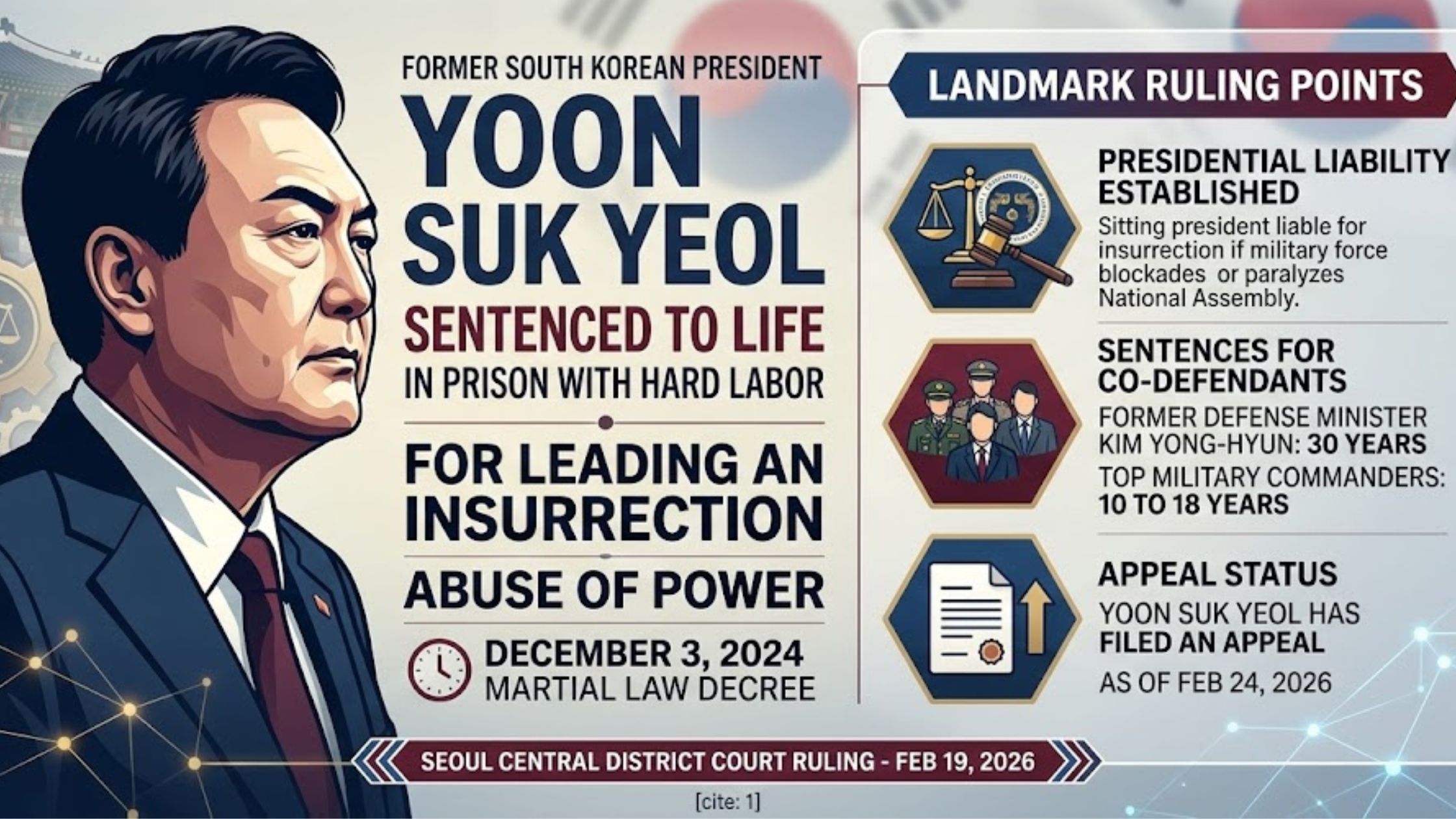
Court rules former president sought to paralyse parliament; co-defendants receive lengthy prison terms
South Korea’s former president Yoon Suk Yeol has been sentenced to life imprisonment with labour after being found guilty of leading an insurrection in connection with his December 2024 declaration of martial law. The ruling, delivered by the Seoul Central District Court, marks the first time an elected leader in the country’s democratic era has received the maximum custodial penalty for such a charge.

The court determined that Yoon’s order on Dec. 3, 2024 was aimed at disrupting the constitutional order by using military force against the legislature. Presiding Judge Ji Gwi-yeon said the declaration imposed “enormous social costs” and found little evidence of remorse during the proceedings. The court concluded that Yoon directly and actively planned the operation.
In its judgment, the court said the purpose of the martial law order was to deploy troops to the National Assembly, seal off the main chamber and detain key political figures, including the speaker and party leaders. Judges found that the move was intended to prevent lawmakers from convening, debating or voting, effectively paralysing the legislature.
The court also stated that the decree damaged the political neutrality of the military and police and weakened public confidence in state institutions. It said the episode harmed South Korea’s international credibility and intensified political divisions at home.
Prosecutors had requested capital punishment, but the court instead imposed a life sentence. In explaining its decision, the bench said that despite the seriousness of the offence, the operation lacked thorough preparation, there were signs that force was limited, and the effort ultimately failed within a short period. South Korean law provides three sentencing options for leading an insurrection: the death penalty, life imprisonment with labour, or life imprisonment without labour.
The December 3 Crisis
The charges stem from events on the night of Dec. 3, 2024, when Yoon declared martial law, accusing opposition forces of “anti-state” activity and raising unproven claims of election fraud. Prosecutors said he ordered troops to surround parliament and take action against the national election commission during a six-hour standoff.
That night, 190 lawmakers forced their way past soldiers and police to enter the assembly chamber. They passed an emergency resolution lifting the martial law order. Within 11 days, parliament voted to impeach Yoon. Four months later, the Constitutional Court upheld the impeachment and formally removed him from office.
Co-Defendants and Wider Legal Fallout
The court also issued sentences for several co-defendants. Former Defence Minister Kim Yong-hyun received 30 years in prison for his role in coordinating the plan. Other senior police and intelligence officials were given terms ranging from three to 18 years, while two individuals were acquitted. Earlier related rulings had characterised the events as an attempted “self-coup” by an elected government.
Outside the courthouse, reactions reflected the country’s political divide. Supporters of Yoon gathered with national and US flags, some protesting the decision, while progressive groups nearby welcomed the verdict. The contrasting responses highlighted the continuing tensions surrounding the case.
Appeal and Remaining Trials
Yoon has denied the charges, arguing that he acted within presidential authority to restore order and counter what he described as obstruction by the opposition. His legal team criticised the ruling as politically influenced and said they would consider filing an appeal.
He remains in custody and faces additional criminal proceedings linked to the martial law episode, including a treason case related to alleged attempts to provoke tensions with North Korea. The appeals process could extend the legal battle for months or longer, keeping the events of December 2024 at the centre of South Korea’s political and legal debate.