




President Lee’s visit underscores urgency of digital infrastructure recovery and addresses political scrutiny amid restoration delays
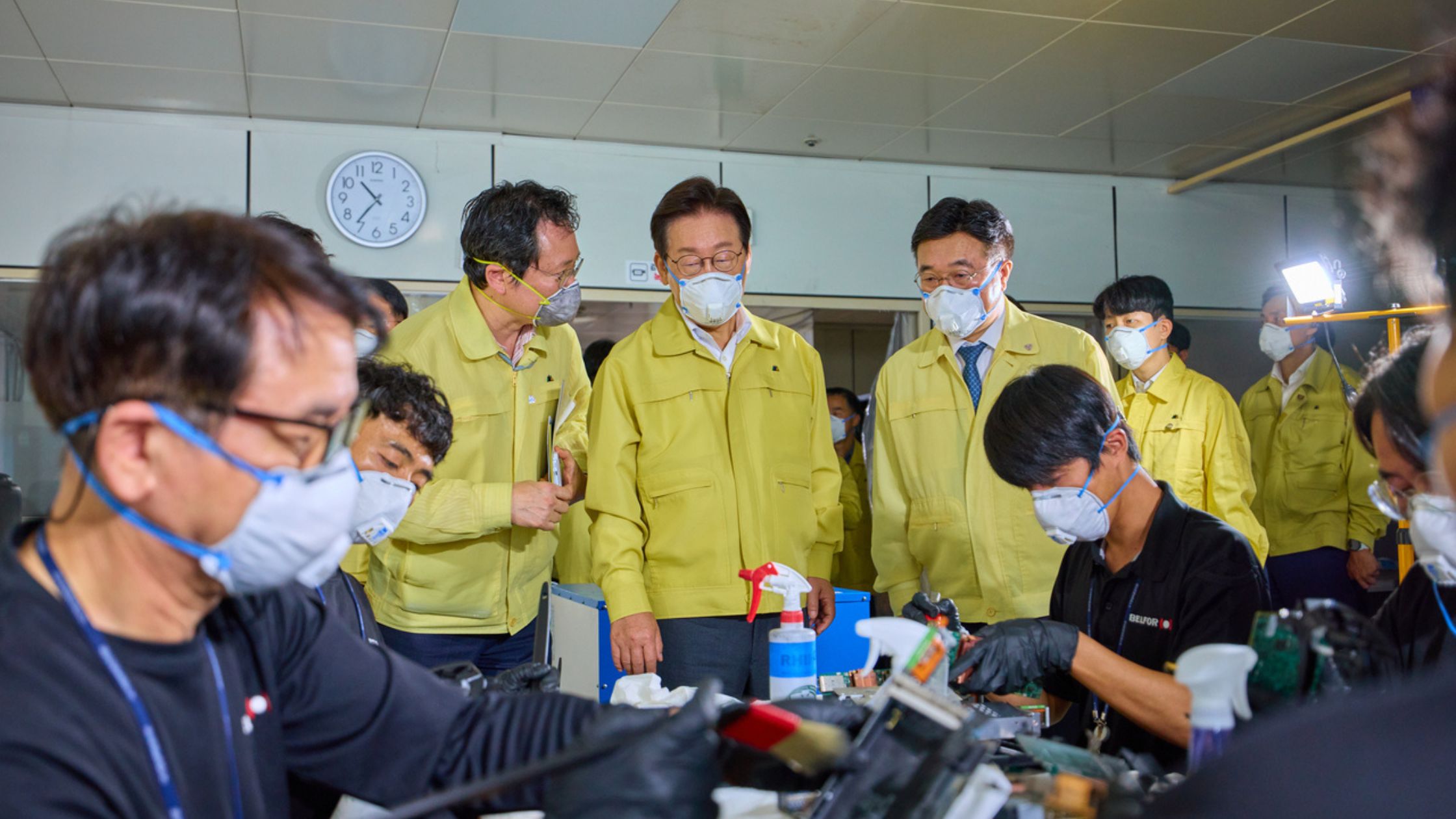
President Lee Jae Myung on Friday inspected the National Information Resources Service (NIRS) in Daejeon to review ongoing recovery efforts after a massive fire last month severely damaged the government’s primary data center. The incident destroyed critical servers and brought hundreds of public administrative systems to a halt, leading to a large-scale restoration effort that has continued for several weeks.

The presidential office stated that Lee’s visit was intended to motivate the government personnel and private teams working on the recovery and to demonstrate the administration’s commitment to resolving the crisis. By Friday, about 30 percent of the center’s digital services had been brought back online, and officials said restoration efforts are being accelerated to fully normalize operations soon.
Inspecting the Scene and Questioning Safety Measures
Upon arrival, President Lee received a briefing on the site’s fire suppression systems and toured areas affected by the blaze. He examined the water tank where lithium-ion batteries had been submerged for cooling and visited the server room where the fire first broke out. During the inspection, he questioned officials about the origin of the blaze and the safety protocols in place for storing batteries prior to the explosion.
The fire, which began on September 26, was traced to a lithium-ion battery that exploded in the server room. It took nearly a day to extinguish the flames, which caused extensive damage to data storage systems and paralyzed around 700 online services used by various ministries and agencies.
Emphasis on Swift Restoration and Prevention
Following a report from Interior Minister Yun Ho-jung, President Lee emphasized that the government’s top priority was to achieve complete restoration “as swiftly as possible.” He directed ministries to deploy personnel and budgets efficiently, calling for closer coordination among agencies responsible for data management.
Lee compared the importance of safeguarding national digital infrastructure to that of national defense, stressing that “airtight prevention measures” must be implemented to prevent similar incidents in the future. His remarks reflected growing concern about the country’s reliance on centralized data systems and the vulnerabilities exposed by the fire.
Addressing Worker Safety and Welfare
Lee also addressed safety concerns following the death of an Interior Ministry official who fell while conducting restoration work on October 3. He instructed government bodies to ensure that recovery operations are carried out under safe conditions and that workers are not exposed to physical or psychological stress.
His statement came amid reports of long working hours and high pressure on public servants involved in the recovery process. The president’s comments were seen as an acknowledgment of the human toll behind the government’s race to restore online systems crucial to daily administration.
Political Reactions and Public Scrutiny
Despite the focus on recovery, Lee’s visit sparked political debate. Some critics suggested the timing was influenced by backlash over his recent appearance on JTBC’s cooking program Please Take Care of My Refrigerator, which aired while recovery work was still underway. Opposition lawmakers accused the president of appearing insensitive to the crisis, while observers noted that the visit—made on what was originally a scheduled day off—might have been intended to counter negative public sentiment.
The presidential office dismissed such claims, stating that the visit had been planned in advance and was intended to support officials who worked through the Chuseok holiday. The ruling Democratic Party defended Lee’s television appearance as an effort to promote Korean food culture, whereas the opposition People Power Party criticized it as ill-timed amid a nationwide disruption of public digital services.
Restoration Progress and Ongoing Investigation
According to the Ministry of Interior and Safety, 217 of the 709 affected government systems—representing about 30.6 percent—had been restored by Friday afternoon. The list includes the Public Procurement Service’s next-generation shopping platform, the Interior Ministry’s records management system, and the Finance Ministry’s National Assembly business support network.
The Central Disaster and Safety Countermeasures Headquarters reported that 30 of 40 “Grade 1” essential systems, classified based on user volume and administrative importance, are now operational. Newly restored services include the privacy regulator’s personal data leak check platform and the labor ministry’s fines management system.
Authorities continue to investigate the cause of the fire, focusing on the lithium-ion batteries that sparked the initial explosion. The incident has drawn renewed attention to the country’s digital safety standards and raised calls for diversification of data storage sites to reduce single-point vulnerabilities in national systems.
A Call for Stronger Digital Safeguards
The Daejeon fire has exposed deep concerns about South Korea’s dependence on centralized data centers, which form the backbone of e-government services. Experts argue that the disaster underscores the need for stronger cybersecurity protocols, improved emergency power systems, and decentralized storage to prevent future large-scale disruptions.
As recovery efforts continue, President Lee’s administration faces dual challenges: restoring operational stability and rebuilding public trust. The tragedy has become not only a technical issue but also a political test of the government’s ability to protect the nation’s digital infrastructure—now recognized as a critical element of national security.