


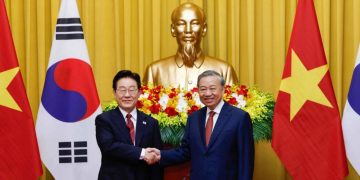


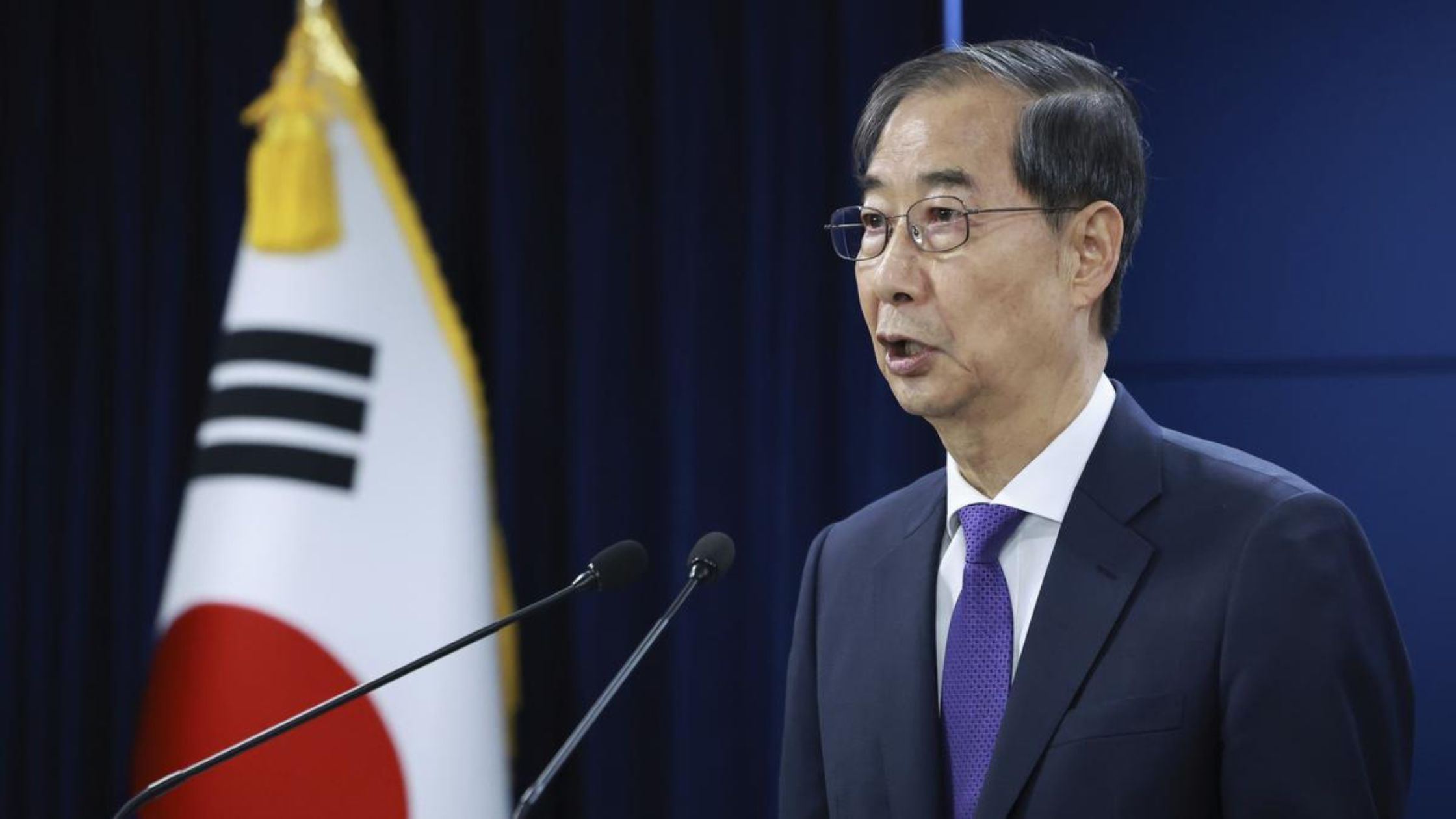
Han Duck-soo, South Korea’s acting President, stepped down on Thursday in a move widely seen as a precursor to his anticipated presidential bid. His resignation comes ahead of the June 3 vote, which was triggered by the impeachment and ouster of former President Yoon Suk Yeol.

During a televised broadcast, Han explained that his resignation was aimed at assuming a greater duty in serving the country. Local news outlets indicate that he is expected to officially kick off his presidential bid on Friday, establishing himself as a prominent figure among conservatives.
Mr. Han’s decision to resign comes amid growing political tension sparked by a recent Supreme Court ruling that could derail the candidacy of Lee Jae-myung, the Democratic Party’s presidential nominee and current front-runner. Earlier on Thursday, the top court overturned a previous acquittal of Mr. Lee on election law charges, sending the case back for retrial. Although the court indicated it considered Mr. Lee guilty, a final verdict will depend on the lower court’s next ruling and subsequent review by the Supreme Court.
Under South Korean law, a fine exceeding 1 million won (approximately $700) for election violations would disqualify Mr. Lee from running for office for five years. The uncertainty surrounding the timeline for the lower court’s new decision has cast a shadow over his campaign, giving conservative rivals an opportunity to question his eligibility. Despite the setback, Mr. Lee has vowed to press ahead, stating that the public, not the courts, should decide the country’s future.
The political landscape has been in flux since former President Yoon Suk Yeol was ousted following his controversial declaration of martial law in December. Mr. Han, appointed by Mr. Yoon as prime minister, took over as acting president but was also impeached before being reinstated by the Constitutional Court. His resignation now leaves a leadership vacuum, with Deputy Prime Minister Lee Ju-Ho expected to serve as acting leader after Finance Minister Choi Sang-mok declined the role and stepped down.
Mr. Han, 75, is widely viewed as a seasoned bureaucrat with decades of experience in economic and diplomatic affairs. A Harvard-educated economist, he has served in various high-level government roles, including finance minister, trade minister, and ambassador to the U.S. He has held the position of prime minister twice — first under a liberal president and later under a conservative administration — and is now seen as a potential unifying figure for the fractured conservative bloc.
Although Mr. Han has yet to officially declare his candidacy, political observers expect him to align with the People Power Party, which is struggling to regroup after supporting Mr. Yoon. The party is set to nominate its own candidate this weekend, and coordination between the nominee and Mr. Han may be necessary to avoid splitting the conservative vote. Meanwhile, the Democratic Party has criticized Han’s resignation, accusing him of abandoning his duties in pursuit of personal ambition.
Mr. Lee’s legal troubles stem from a suspended prison sentence handed down in November for making false claims during his last presidential run, which he narrowly lost to Mr. Yoon. Although an appeals court cleared him in March, the Supreme Court reversed that decision on Thursday, reopening the case. The outcome could bar him from running if the lower court issues a heavier penalty. The renewed legal battle has further intensified political divisions, with rallies held outside the court as both supporters and critics voiced their anger.