




Government opens path for expanded investigation and tighter security for political figures
South Korea has formally classified the January 2024 stabbing of President Lee Jae Myung as an act of terrorism, according to local media reports on Tuesday. The decision was made at a meeting of the National Counterterrorism Committee, marking the first time a specific incident has been designated as terrorism since the country’s anti-terrorism law took effect in 2016.

The committee, chaired by Prime Minister Kim Min-seok, concluded that the knife attack met the legal definition of terrorism under the Act on Counter-Terrorism. Officials said the designation reflects the government’s view that the attack went beyond a personal crime and posed a direct threat to democratic order and public safety.
Details of the 2024 attack
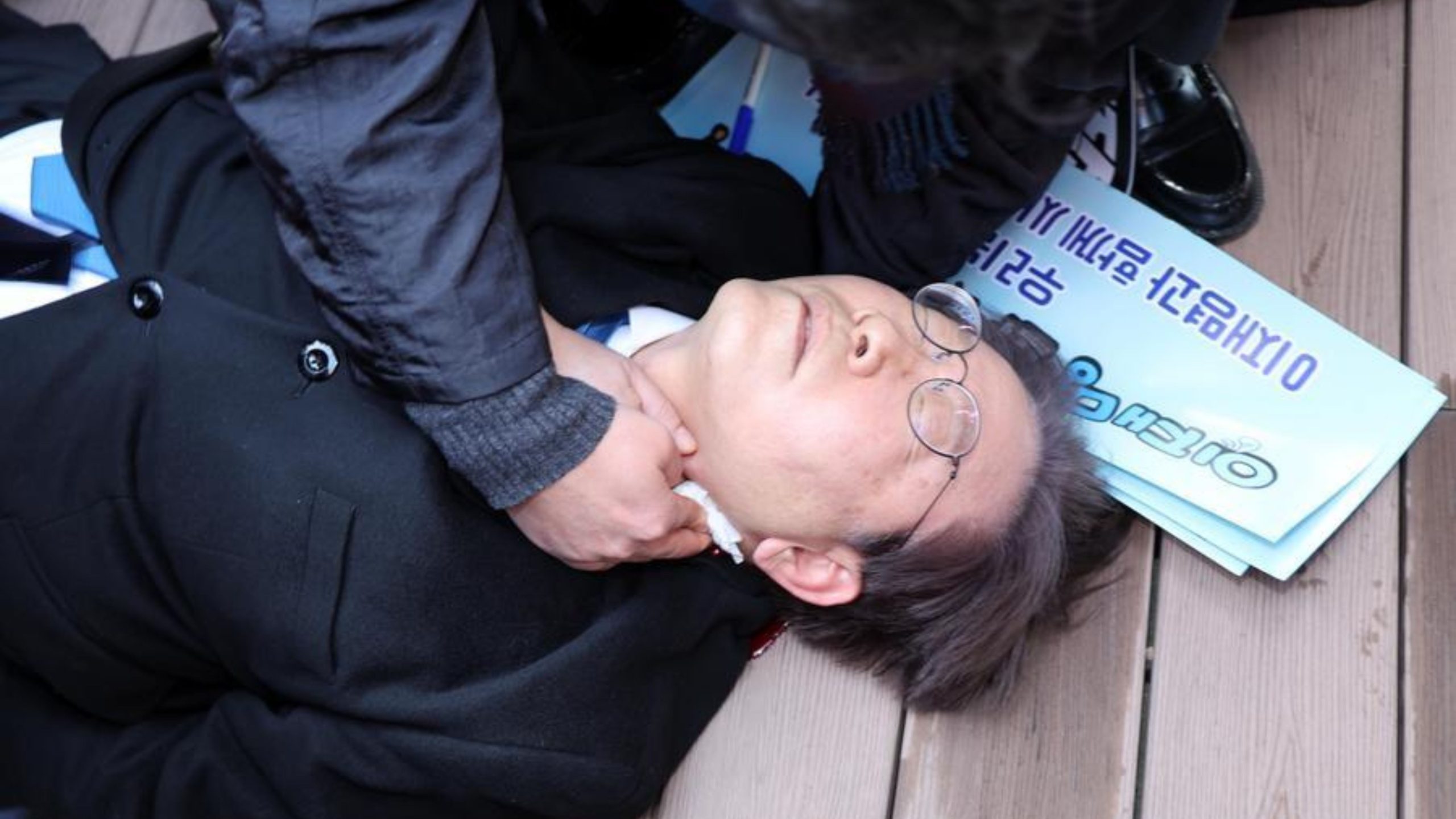
The stabbing occurred on Jan. 2, 2024, when Lee was visiting the Gadeokdo new airport construction site in Busan and speaking with reporters after a tour. At about 10:27 a.m., a 67-year-old man identified as Kim Jin-sung approached Lee under the pretext of asking for an autograph, wearing a paper crown and holding a pen and paper. He then suddenly lunged at Lee and stabbed him on the left side of his neck with a long knife, according to police reports.
People near the scene immediately intervened, shielding Lee while applying pressure to the wound. Lee, who remained conscious after the attack, was taken by ambulance to Pusan National University Hospital about 20 minutes later and then airlifted to Seoul National University Hospital for further treatment. Medical staff said the cut was about one centimetre long and had damaged his jugular vein, raising concerns about heavy bleeding before emergency surgery.
The assailant was arrested on the spot and told investigators he intended to kill Lee. He was later tried and, in July 2024, received a 15-year prison sentence for attempted murder and related charges
In February 2025, the Supreme Court finalized a 15-year prison sentence for the assailant, bringing the criminal case against the individual to a close. However, questions surrounding the broader context of the attack and its initial handling by authorities remained unresolved, prompting renewed scrutiny.
Why the terrorism designation matters
By formally labeling the attack as terrorism, the government has created a legal basis to reopen and expand the investigation. The prime minister’s office said an additional probe would examine unresolved issues, including whether the incident was properly assessed and managed in its early stages.
The designation also allows counterterrorism authorities to apply broader investigative tools that were not previously used when the case was treated as an isolated violent crime.
The Democratic Party has accused the National Intelligence Service and other agencies under the former administration of President Yoon Suk-yeol of downplaying the severity of the attack. Party officials alleged that evidence at the scene was damaged or removed and that authorities failed to classify the incident as terrorism despite its political nature.
These claims have intensified calls for an independent and transparent review of how the case was initially handled.
New investigation and security measures
Following the committee’s decision, the National Investigation Headquarters under the National Police Agency announced the formation of a special task force. The unit will examine whether there was any collusion, why the terrorism label was not applied earlier, and whether evidence was mishandled during the first response.
Prime Minister Kim said the attack should never have occurred and pledged to strengthen South Korea’s counterterrorism framework. As part of follow-up measures, the government said it would reinforce protection for key political figures, particularly during election periods.
The case has revived public debate over political violence in South Korea, which has experienced several high-profile attacks on political figures over past decades. Analysts say the decision to classify the stabbing as terrorism signals a firmer stance against threats to democratic institutions, while also raising expectations for accountability and stronger safeguards for public officials going forward.