






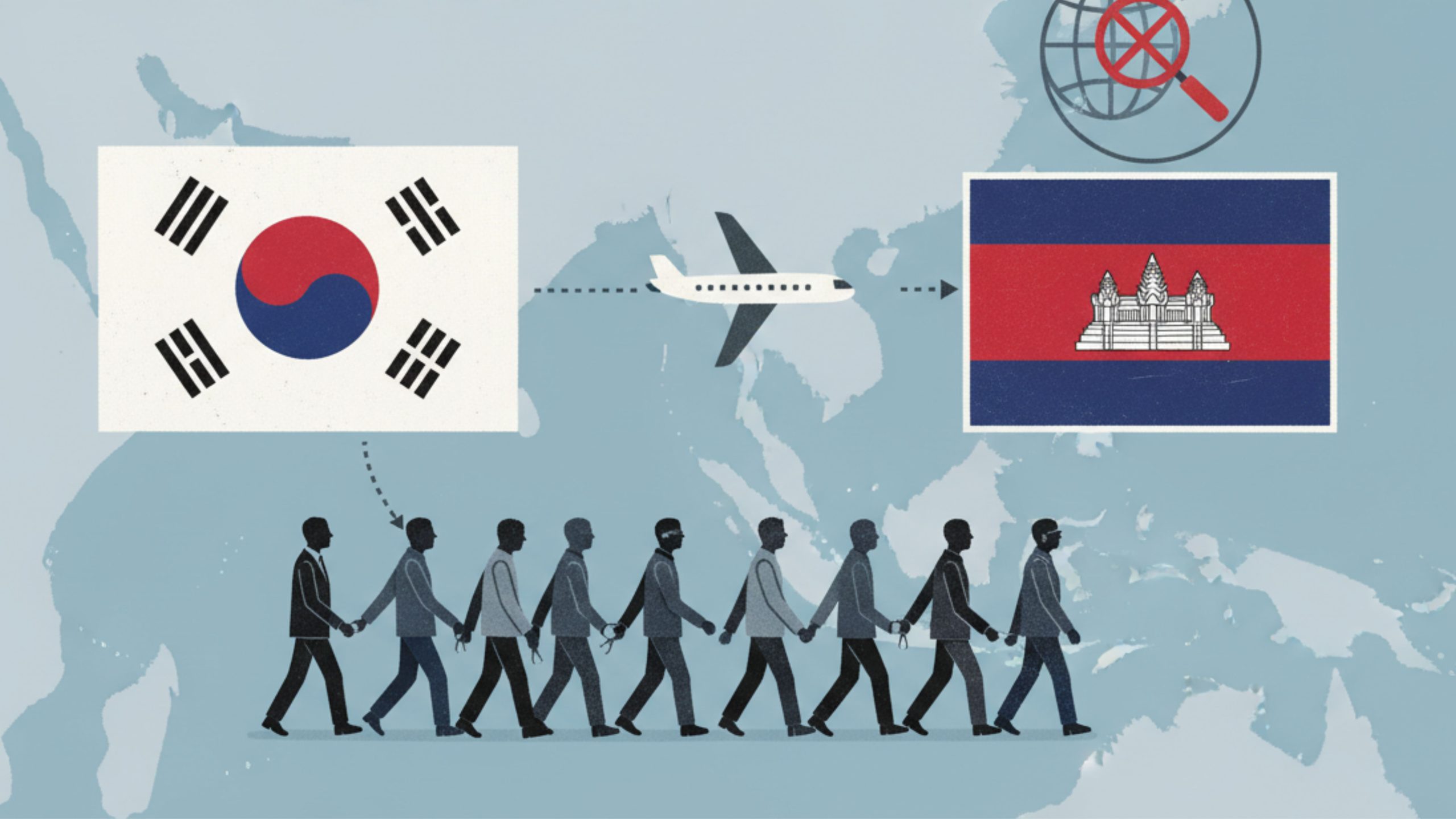
Largest group return reflects growing public pressure and expanded cooperation with Southeast Asian authorities
South Korean authorities on Friday brought back 73 nationals suspected of operating online scam schemes in Cambodia, marking the largest-ever repatriation of South Korean criminal suspects from overseas. The group arrived on a chartered flight at Incheon International Airport and was immediately transferred to police stations nationwide for questioning, according to government officials.

The suspects are accused of defrauding fellow South Koreans of about 48.6 billion won (roughly $33 million) through online fraud operations run from Cambodia. Their return comes amid heightened public anger over foreign-based scam centers, which intensified after a South Korean college student was found dead in Cambodia last year.
According to Yonhap News Agency, television footage showed 65 men and eight women arriving in handcuffs and wearing face masks before being escorted onto buses under heavy police guard. Authorities said the suspects will be questioned over their alleged roles in multiple scam operations targeting South Korean victims.
Investigators believe the group defrauded at least 869 people through romance scams, investment fraud, and other online schemes. Officials linked the suspects to seven scam centers operating in Cambodia, which allegedly functioned as organized fraud hubs.
Deepfake scams and organized networks
Investigators said the repatriated group includes a married couple suspected of playing a central role in a large-scale romance scam that relied on deepfake technology. Authorities believe the pair used artificially generated images and videos to create fake online identities, building long-term emotional relationships with victims before persuading them to transfer money. The scheme is estimated to have extracted about 12 billion won from more than 100 people.
Police said the case highlights how overseas scam groups are increasingly adopting generative artificial intelligence to make fraud more convincing and harder to trace. By using deepfake tools and operating from abroad, such networks are able to impersonate real individuals, evade early detection, and scale their operations quickly.
Investigators added that the suspects may have undergone plastic surgery in an attempt to avoid identification, underscoring the level of planning and organization behind the operation.
Public outrage and political pressure
Public attention turned sharply toward overseas scam operations after a South Korean college student was discovered dead in Cambodia. Authorities said he had been compelled to work at a scam facility and bore signs of severe abuse, sparking nationwide anger and intensifying demands for tougher measures to safeguard South Koreans overseas.
Senior police officer Yoo Seung Ryul said law enforcement would relentlessly track down individuals involved in crimes against South Koreans and hold them fully accountable. He added that the latest repatriation was one step in an ongoing campaign to break up cross-border fraud networks.
The suspects were among about 260 South Koreans detained in Cambodia in recent months as part of a joint crackdown coordinated by Seoul and Phnom Penh. Officials said the latest repatriation followed a bilateral investigation supported by repeated consultations between police, justice, and foreign ministry officials from both countries.
Since October, South Korean officials have repatriated around 130 suspected scam operators from Cambodia, as well as more than 20 others from the Philippines, Thailand, Vietnam, and Laos. Police said roughly 60 South Koreans remain in custody in Cambodia and are awaiting transfer back home.
A wider regional problem
Online fraud has grown sharply across Southeast Asia, with Cambodia and Myanmar emerging as key hubs. Many of these operations rely on trafficked foreign workers who are coerced into running scam schemes. The UN Office on Drugs and Crime estimates that global victims lost between $18 billion and $37 billion to scams in 2023.
Many workers, the agency said, were recruited with false job offers and later held in conditions approaching modern slavery. South Korean officials have warned that some of their citizens remain trapped in such operations, underscoring the challenges of enforcement beyond national borders.
The mass repatriation highlights South Korea’s growing focus on transnational cybercrime, combining law enforcement action with diplomatic coordination. While the return of the 73 suspects marks a significant step, authorities acknowledge that dismantling overseas scam networks — and rescuing potential victims — will require sustained regional cooperation and long-term policy responses.